














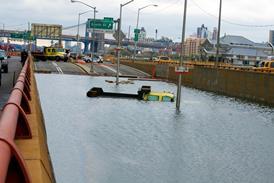



Keeping systems up and running will become more important as the world becomes a riskier place. Simon Rawlinson of Arcadis examines how the resilience agenda is evolving, the role of climate change in raising the stakes, and the strategies UK infrastructure owners are adopting to invest in resilience
01 / What is infrastructure resilience and why is it important?
Even as the UK races to reduce carbon emissions, we must prepare for the inevitable consequences of climate change. Updated scenarios forecast more extreme impacts, even as the net zero consensus breaks down. Infrastructure needs to be designed and operated with resilience in mind, anticipating, responding to and recovering from an increasing range of risk events.
The UK’s state of readiness is increasingly in focus. The Climate Change Committee (CCC) recently highlighted updated resilience requirements, in October 2025. When preparing a 2026 update to its Well Adapted Britain initiative, the CCC assumes that a 2ºC threshold will be breached by 2050. The implications are for a significant increase in the intensity of climate change events, with a corresponding impact on the resilience of existing and planned infrastructure.
The CCC’s latest submission highlights the prospect that extraordinary weather events will become ordinary and that, in the words of the UK Green Building Council, existing infrastructure has been designed for a world that no longer exists. The impacts could be profound, for example by changing patterns of electricity usage into a double annual peak due to air-conditioning use during hotter summers. Such a change would affect energy consumption and the timing of repair and maintenance cycles, as well as putting infrastructure under physical strain.
Net zero strategies also have implications for the resilient operation of infrastructure, illustrated by recent nationwide grid failures in Spain, which highlight that the operation of low carbon energy systems is less predictable. When voltages spiked in April 2025, there was not enough inertia in the network to regulate the grid, and standby gas generation did not respond quickly enough – triggering the shutdown. Grid resilience can be increased through investment in network stability, through the design of the energy market and also the retention of black start (restoring power without an external source) capability – based on battery storage, for example. All this functionality will have a cost and highlights how holistic a resilience strategy needs to be – covering market design and system operation as well as the design and maintenance of infrastructure assets.
Although climate change represents the greatest long-term threat to infrastructure resilience, there are many other factors at play. Population change and development will exacerbate drought and storm resilience both by increasing water consumption and by increasing the intensity of storm runoff.
>>See also: Market forecast: Construction sector hangs in the balance
>>See also: Procurement update: The importance of navigating frameworks
Planning for resilience involves responding to predictable change like population growth and unpredictable events including asset failure. Ageing and complex infrastructure networks are vulnerable to risks including cyber-attack or to catastrophic, sequential failures such as the fatal Stonehaven rail crash, where failures in construction, maintenance and rail operation all combined to create the conditions for a preventable accident.
Stonehaven is an example of a cascade event affecting multiple systems. The North Hyde fire, which triggered the shutdown of Heathrow Airport, described in the case study opposite, highlights how complex the relationships between infrastructure systems can be.
Following the covid-19 pandemic, resilience has been given a much higher profile in the assessment and the subsequent National Infrastructure Strategy, with a particular focus on long-term investment in existing assets, flood risk, and the assurance of water supply. However, there remain many gaps that need to be filled, from information on asset health to a better understanding of how resilience risks combine to reinforce one another.
Despite the gloomy prognosis, failures affecting infrastructure have decreased in recent years, with the frequency of power cuts having halved for example. Looking forward, focusing on anticipation and assessment – developing new resilience standards and implementing regular stress tests will play a key role in ensuring that the UK’s infrastructure is fit for purpose in a rapidly changing world.
Table 1: Latest climate change impact scenarios modelled by the Climate Change Committee
| Scenario | Changes to model details |
|---|---|
| Drought | Double the total amount of time during which drought-intensity events will occur after 2050 compared with the reference period (1981 to 2010) |
| Flooding | For 2050, compared to the reference period: Peak rainfall up by 10%-15% for wettest days Peak river flows up by 40% Sea levels up by 15cm-25 cm |
| Heatwaves | 80% chance of a defined heatwave occurring in 2050 compared with a 40% chance during the reference period. |
| Wild fire risk | Doubling of days with wild fire risk across at least 5% of England and Wales compared with the reference period |
Source: Climate Change Committee, October 2025
Case study: North Hyde electrical substation failure leading to Heathrow shutdown

A fire occurred in a single supergrid transformer in the North Hyde substation which tripped in sequence the two other supergrid transformers on the site, resulting in a complete loss of power from the substation. All power on one of three supplies to Heathrow Airport was lost as a result of the shutdown. The incident report notes that problems affecting the failed transformer had been identified but that maintenance had been deferred by National Grid, the transmission owner. The report also notes that the substation did not meet updated standards for physical separation used to manage fire risk.
Heathrow Airport’s private distribution network has three supplies but was configured in such a way that loss of a single supply would result in a loss of power to critical systems. This risk was known and was assessed as being low due to the resilience of the transmission infrastructure. Heathrow had plans in place for a shutdown and system reconfiguration, and these were implemented as part of the event. Heathrow’s critical dependence on the reliability of the network had not been communicated to either transmission or network operators. The supply network was not designed to provide additional protection, and maintenance had not been prioritised to address the additional risk.
The case study highlights that National Grid, Heathrow Airport and other parties were all taking risk-based decisions about the configuration and operation of their critical assets in isolation. As a result, the compounding of the risk was not fully understood. Many steps could have been taken to mitigate the risk, including improved asset management, increased expenditure on maintenance or the reconfiguration of networks to higher and more costly standards. Ultimately the lack of a mutual understanding of cascading risks by the network operator and its customers created a blind-spot that resulted in a very disruptive incident.
02 / How the need to invest in resilience is growing
As 2050 gets closer and the impacts of climate change become more evident, there is a growing focus on adaptation to those effects. For example, the CCC envisage impacts on people’s health and wellbeing, food security, economic growth and the maintenance of public services under increasingly extreme conditions. Infrastructure has a key role in this adaptation, in that the CCC’s aim is to maintain service levels at current standards.
In the 2023 National Infrastructure Assessment, the National Infrastructure Commission (NIC, now NISTA) estimated infrastructure investment would need to rise from an average £55bn per year to a range of £70bn-£80bn per year in the 2030s to build resilient infrastructure on top of a net-zero carbon economy.
This scale of potential investment points to further problems with making the business case for resilience. Firstly, costs are paid for in advance by the provider and customers, whereas benefits are accrued by wider society – but only if a risk event occurs. This means that achieving a balance between short-term cost savings and a “gold-plated” risk profile is a priority. Optimism bias – the belief that risk events will not occur – makes it even harder to support the business case, increasing the risk that resilient investments will be too little, too late. This explains why regular system-wide stress tests and regularly updated standards are so important and why the regulator’s resilience remit is such a valuable tool.
Major climate change risks affecting buildings and infrastructure are summarised in table 2, highlighting the scale of expensive mitigation measures – including new reservoirs and flood barriers – that are necessary to facilitate climate change adaption. Increased heat is a growing concern, due to its effects on the safe operation of road and rail networks.
Nature-based solutions will play a key role in mitigation. Flood risks for rail and road infrastructure can be managed by providing “space for water” – a strategic approach integrating water management and green infrastructure into land-use planning – as part of a wider environmental services strategy. However, this in turn requires much more extensive stakeholder engagement and the transfer of risks – loss of agricultural production, for example, rather than interruption to the road or rail network.
Table 2: Mitigation measures necessary to facilitate climate change adaption
| Risk source | Definition of risk event | Potential impacts | Potential mitigations |
|---|---|---|---|
| Drought | Variable, depending on duration and impacts | * Direct effects on farming, rivers and nature * Water shortages * Increases other hazards – fire and flood |
* Water saving, including leak reduction * Water storage and water transfer * Drought-resistant landscape |
| Flooding | Overflow of water that submerges land or enters property | * Physical damage to assets * Disruption to use of assets * Loss of wildlife and crops |
* Flood-protected locations * Nature-based solutions * Physical barriers * Water-resistant materials and systems |
| Overheating | Temperatures exceeding thresholds defined by recent average temperatures | * Damage to buildings and infrastructure * Service interruptions * Health impacts, including disease control * Reduced productivity |
* Material and product specifications * Passive design solutions * Mechanical cooling |
| Storm | Event thresholds defined by wind speed and intensity of rainfall | * Wind damage * Exacerbated flood damage |
* Strengthening of assets * Risk mitigation through orientation and siting |
| Wild fire | Uncontrolled vegetation fires that require action | * Threat or damage to assets and networks * Service interruptions * Injury risk and displacement * Liabilities for network operators |
* Fire-safe landscapes * Fire-suppression measures |
Source: UK Green Building Council
03 / Planning for the worst – how the UK’s resilience strategy is evolving
Given the multidimensional nature of resilience risks, the UK resilience strategy, led by the Cabinet Office, has several interlocking components. These are best summed up in the National Infrastructure Commission’s 2020 Anticipate, React, Recover plan. The plan highlights the key role of government in incentivising investment in resilience and some of the weaknesses in practice and standards at the time of publication. The NIC recommended an updated approach to demonstrating resilience, based on three key steps:
- The setting of new resilience standards
- A refreshed role for regulators
- An updating of resilience strategies.
The recommendations have been adopted in part, but the UK’s approach remains a work in progress, as shown for example by the high-level nature of the recently published National Resilience Action Plan.
Key components of the UK’s current approach include:
Critical national infrastructure
CNI is defined by the government as the assets, systems, networks and processes that are necessary for the delivery of essential services. Infrastructure qualifies as CNI if it supports an essential service such as energy, if it cannot be easily restored and if its compromise would have a detrimental effect on security, safety or the economy. Over 85% of the UK’s CNI is in private ownership. Each sector has a lead government department that is responsible for risk assessment and planning. The Cabinet Office provides oversight alongside security authorities. Many but not all CNI owners have statutory resilience obligations enforced by regulators.
Climate change risk assessment
CCRA is a requirement of the Climate Change Act. CCRA3, published in 2022, identified 61 climate change related risks or opportunities based on an assessment of climate hazards, exposure scenarios and system vulnerabilities. The assessment found that many of the priority risk areas could result in risk-related damages exceeding £1bn per year by 2050 under a 2ºC warming scenario. Worryingly, CCRA3 highlighted limited success in prior preparations for climate change adaptation, but mitigation of this risk was actioned up in the subsequently published National Adaptation Plan.
National Security Risk Assessment
Since 2023, the NSRA has involved a continuous, rolling assessment of security risk, including resilience risks for infrastructure. The assessment distinguishes between acute risks, such as a power failure, and chronic risks including climate change or population. Implications for infrastructure owners of this approach include a greater focus on interdependence between sectors as well as encouragement by regulators for the adoption of data-driven investment in infrastructure resilience.
National Resilience Action Plan
The NRAP, published in July 2025, has three objectives:
1. Putting in place a continuous risk assessment system
2. Enabling all society, including the private sector and public, to increase their own resilience
3. Strengthening the public sector resilience system, for example by better connecting different elements.
The NRAP is a high-level strategy. Nationwide mobile phone tests, for example, are part of NRAP. NRAP includes measures aligned to CNI, including the development of an interactive risk map and actions to ensure that all standards supporting resilience are fully utilised. However, NRAP does not include any specific measures as recommendations for investment in infrastructure resilience
National Adaptation Plan
NAP3, published in 2023, is required under the Climate Change Act. The NAP describes the UK’s overall approach to all aspects of adaptation, including those affecting the natural environment, industry and international relations. There is a specific focus on infrastructure, summarising measures put in place to cover the resilience of specific systems such as the rail and road networks. The NAP model for infrastructure can be summarised as:
1. Ensuring the regulatory framework mandates climate adaptation outcomes
2. Directing sufficient investment into networks
3. Active engagement with operators and their regulators to secure improvements in performance and resilience.
NAP3 was heavily criticised in part due to limited progress in the preceding period, but mainly due to a lack of measurable goals for any sector. Subsequently, more focus has been placed on information gathering and research, including smarter data systems ahead of the completion of CCC progress reports due in 2025.
National Policy Statements
NPSs have been updated to require consideration of resilience over the lifetime of the asset, building on a previous focus on carbon reduction. A regular updating is now needed so that requirements keep pace with changing risk scenarios.
National resilience standards
NRSs are a work in progress. The Cabinet Office is due to publish standards by the end of 2025, based on NIC recommendations. Initial work covered telecoms, energy, transport and water, highlighting resilience gaps, detailed considerations for standards setting and actions for government departments. The NIC described four types of standard, contributing to the UK’s resilience system:
1. Customer outcome standards including service interruptions that inform regulatory incentives and penalties
2. System performance standards, describing expected performance in defined circumstances such as minimum resilience in transmission networks
3. Technical asset standards such as thermal ratings for overhead lines
4. Recovery standards, describing support provided during service breakdown as well as service restoration targets.
>> Click here for more infrastructure market reports
The NIC’s work has highlighted the challenges of setting standards, including complex trade-offs. For example, whether it is better to invest in more in system resilience than rapid service recovery to a failure. Part of the challenge is that standards need to be defined and modelled before the costs of meeting them can be understood. Finalising NRS is an iterative process.
In summary, gaps in the UK’s infrastructure resilience remain. Many targets and standards for robustness or for recovery are yet to be fully defined, and the mechanisms for ensuring compliance are a work in progress. The UK has better frameworks in place, and these will no doubt be tested as resilience incidents grow in scale and complexity.
Case study: Lower Manhattan coastal resilience
After Hurricane Sandy struck New York City in 2012, causing 44 fatalities and US$19bn in damage, the city and its partners launched one of the world’s most ambitious urban resilience programmes: the Lower Manhattan Coastal Resilience (LMCR) initiative, inspired by the original Rebuild by Design “Big U” concept. The Big U proposed a protective ribbon of flood defences and community amenities wrapping around the southern tip of Manhattan. Today, that vision is being implemented through several distinct but co‑ordinated projects, including the East Side Coastal Resiliency (ESCR), Battery Coastal Resilience Battery Park City Resilience, and the forthcoming Financial District and Seaport Climate Resilience Master Plan (FiDi-Seaport).
Arcadis serves as a lead engineering and programme partner on multiple components, notably ESCR and FiDi-Seaport. These projects integrate coastal flood protection with public realm design, ecological enhancements, and upgraded utilities – demonstrating how climate adaptation can improve both safety and liveability.
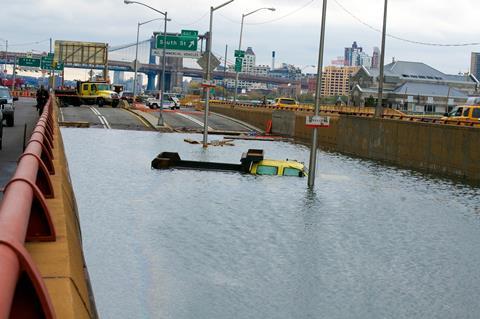
The US$1.5bn ESCR project, jointly funded by HUD and NYC, extends 2.4 miles from Montgomery Street to East 25th Street. It raises East River Park by 8ft-10ft and incorporates concealed floodwalls, gates and upgraded drainage improvements. Construction began in 2020, with the first phase completed this year. The project will protect 110,000 residents, critical infrastructure and affordable housing from a 100-year flood plus 2050 sea-level rise.
Financing future phases of the broader LMCR remains a live challenge. While the first segments were supported by federal Community Development Block Grant Disaster Recovery and city capital funds, later phases such as FiDi-Seaport are exploring blended funding models that may combine federal grants, city capital, and potential value-capture or resilience-bond mechanisms. Sources of revenue that have been explored include surcharges on property taxes, sales taxes, payroll taxes or insurance premium taxes. Funding could also involve the monetisation of climate resilience, through for example the development of insurance products that reward the reduced level of flood risk with lower premiums.
Beyond its engineering scale, the Big U/LMCR effort highlights a fundamental economic truth: the benefits of resilience investments – reduced risk, increased property value, avoided losses and improved public space – extend far beyond the project boundary, making innovative financing and equitable cost-sharing essential for long-term urban viability.
04 / Changing priorities – how are UK infrastructure owners investing in system resilience?
Investment in infrastructure resilience is increasing, but against the background of priorities focused on decarbonising the grid and eliminating sewage spills. Ofwat’s £50bn RAPID programme, focused on closing a projected shortfall of drinking water, highlights the scale of investment that might be required in new capacity.
By contrast, programmes for road and rail focus on existing and ageing infrastructure – 60% of Network Rail’s embankment assets are at least 150 years old. The table below summarises major initiatives being undertaken by groups of infrastructure owners.
The analysis highlights the range of scale among these interventions – from mega-scale water storage schemes to localised adjustments in water storage capacity or structural repairs. Such a diverse range of responses, delivered across a geographically dispersed portfolio, relies on prioritisation, which can be facilitated by digital asset intelligence tools that can be programmed to reflect the resilience priorities and decision-making logic of the asset owner. As the need for greater investment in existing assets increases, the value of enterprise-level decision making on resilience priorities can only increase.
Table 3: Major mitigation initiatives undertaken by groups of infrastructure owners
| Sector | Risk exposure | Mitigation benefits | Proposed investment | Actions to be taken |
|---|---|---|---|---|
| Power transmission | * Extreme storms have affected 1-2 million people | * Benefit-to-cost ratio variable due to potential value of lost load (VoLL) | * Existing network resilience delivered as part of a £60bn-plus upgrade programme | * Upgraded design standards * Elimination of single points of failure, including circuit strengthening * Flood protection to substations * Vegetation management on transmission corridors |
| Flood risk | * 2 million people affected n 30% of CNI exposed | * 8:1 benefit on prevention costs vs consequences | * £2.4bn pa increasing to £3.4bn by 2050 | * Changed assumptions for rainfall and water flows * Enhanced flood risk standards * SUDS and storage mandate in flood risk areas * NBS investments * Changes to ground-floor uses in flood risk areas |
| Water stress | * Seven out of 17 water regions in England exposed | * Capacity shortfall of 5 billion litres per day closed | * £2bn for AMP 8 * Long-term investment £50bn for the RAPID programme |
* Develop and deliver the RAPID programme of 28 large‑scale water supply schemes including reservoirs, water recycling and desalination |
| Road transport | * 10%-12% of strategic road network at high to very high risk of flooding by 2040 * Heat-related degradation to double by 2040 |
* Reduced risk to disruption affecting 80 billion passenger road km/pa and 110 billion freight tonne-km pa | * £8bn maintenance and response fund (2028-2036) * £1bn structures fund |
* Enhanced capability to recover from disruption * Updated design manuals n Infrastructure protection – drainage, scour and attenuation capacity * Heat-resistant road surfaces * Climate change resistant embankment design |
| Rail transport | * 12%-15% of network at risk of flooding by 2050 * 14%-16% at risk from earthworks failure by 2050 * 30%-40% of rail exposed to overheating risk by 2050 |
* Reduced risk to disruption affecting 1.6 billion passenger journeys and 15 billion freight tonne-km pa | * £1bn CP7 allocation to improved extreme weather resilience * CP7’s overall allocation to climate change mitigation is £2.8bn |
* Adoption of climate adaption design manual * Drainage and water storage capacity increased * Slope stabilisation including green engineering * Heat stress mitigation for rail and overhead line equipment |
Source: UK Green Building Council
05 / Conclusions
Infrastructure resilience is a holistic process as well as the characteristic of an infrastructure asset. Resilience describes the ability to anticipate, assess, mitigate, respond to and recover from risk events. It requires long-term planning, painstaking, detailed mitigation efforts and the ability to respond to events in real time. Recent events including the North Hyde substation failure have highlighted the significance of cascade risks, where failures in one asset trigger even more severe failures across the system. As the risk profile grows, ranging from cyber-security to the inherent complexity of modern power networks, infrastructure owners will become more reliant on the effectiveness of their resilience planning.
Acknowledgments
The authors would like to thank Matt Bennett, Roni Deitz, Emma Maltby, Anusha Shah and Mathijs Van Den Burgh for their valuable contributions to this article.





No comments yet