










![logo_solarlux_4c[75775]](https://d3sux4fmh2nu8u.cloudfront.net/Pictures/280xAny/7/0/7/2032707_logo_solarlux_4c75775_355263.jpg)
Sponsored by Solarlux, this module, guides specifiers through the key decisions involved in designing and specifying a glazed balcony – from choosing the right acoustic and solar-control glazing to specifying the right fixings and meeting relevant regulations
Deadline for completing this module Friday 7 August 2026
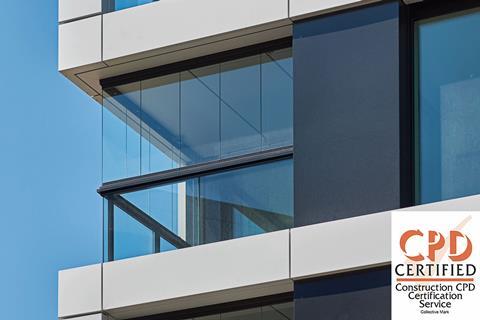
Balconies are among the most valued features in residential developments – but in the UK, an unglazed balcony is often too cold, wet or noisy to use for much of the year. Glazed balcony systems change that, turning exposed outdoor platforms into sheltered, light-filled spaces with real amenity value, which residents can enjoy using in winter as well as summer.
Learning objectives
- Identify the key benefits of glazed balcony systems for residents, including acoustic performance, weather protection and thermal comfort, and understand how these drive specification choices.
- Explain the principal regulatory and standards requirements that apply to glazed balcony design.
- Describe the structural, acoustic, fire safety and drainage performance criteria that must be met when specifying balcony glazing.
What is balcony glazing?
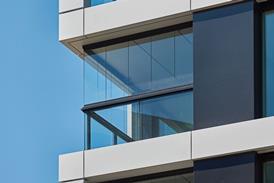
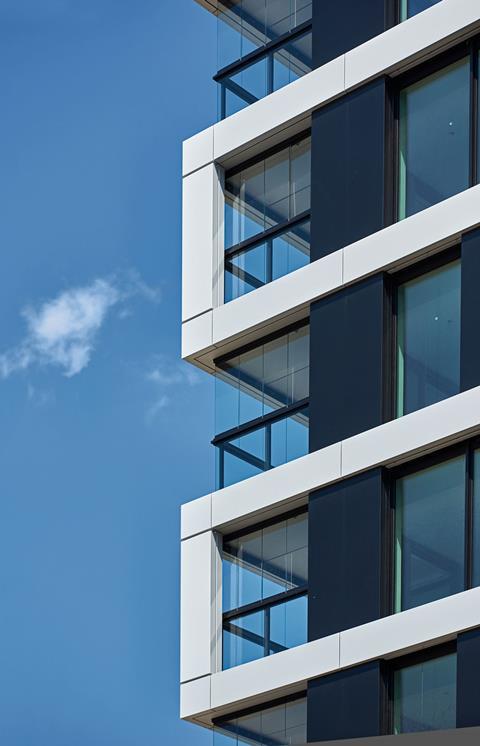
Balcony glazing is a system of frameless or framed glass panels that enclose a balcony. Such systems provide protection from wind, rain and noise to create an outdoor space filled with natural light that can be used all year round. The sleek, modern look of balcony glazing can also enhance a building’s aesthetic appeal.
Balcony glazing can feature sliding, pivoting or folding panels that make it easy to open whenever users want to enjoy pleasant outdoor conditions, and simple to close again if the weather takes a turn for the worse – or if noise from the street gets too intrusive.
The year-round protection from the elements that such balconies offer has practical benefits, too. Balcony furniture can be left where it is during the winter rather than having to be stored elsewhere, and standard chairs and tables can even be used instead of outdoor furniture.
As well as keeping out the elements and noise pollution, some glazed balcony systems are insulated. An insulated glazed balcony can become part of the home’s heated space, making it a comfortable place to relax all year round.
Specifying glazed balconies
Whether you are looking to create a glazed balcony on a new-build or to upgrade an existing balcony with glazing, there are two key areas driving the specification: the benefits the resident will expect to enjoy, and the performance criteria required to comply with building regulations, standards and warranty requirements.
Specification choices driven by residents
Residential customers’ exact requirements will vary, but will probably include some or all of the following factors.
Noise reduction
The glass on a glazed balcony can significantly reduce noise levels. This is especially useful in areas with high levels of noise pollution close to roads, railways or industrial areas. A glazed balcony may also reduce noise levels in rooms inside the home adjacent to the balcony, because the glazing acts like secondary glazing.
The effectiveness of a material as a sound insulator is measured in decibels (dB) and expressed as an Rw value. The higher the Rw value, the greater the acoustic attenuation. Two additional correction terms are applied to account for different noise spectrums: C (covering mid-to-high frequency sources such as children playing, railway noise at medium speed and high-speed traffic) and Ctr (covering low-frequency dominated sources such as urban traffic, aircraft or bass-heavy music). These give composite values of Rw + C and Rw + Ctr, allowing specifiers to select glazing appropriate to the specific noise environment.
For a standard single-pane glass panel, Rw values are typically in the range of 28dB to 32dB. Laminated acoustic glass improves on this thanks to an interlayer – typically polyvinyl butyral (PVB) – sandwiched between two panes of glass that absorbs sound energy and blocks vibrations.
The overall sound reduction is also affected by the framing system, any openable sections, and by the junctions between the glazing and the building facade. Even a small gap or poorly sealed joint can significantly compromise the acoustic performance of an otherwise well-specified system.
The acoustic standard that needs to be met will be set on a project-by-project basis to satisfy local planning requirements, depending on the acoustic profile of the surrounding area.
Weather protection
Glazed balcony systems give users the option to control their exposure to the elements, making better use of the space all year round. They also offer protection against airborne pollutants – in urban areas, fumes from traffic or surrounding industrial areas can limit the appeal of an open balcony, particularly during hot weather. Some systems use a double-skin arrangement, with two layers of glazing enclosing the balcony rather than one. So even if wind-driven rain penetrates the outer skin through gaps around the panels, the inner skin prevents it from reaching the balcony space itself, allowing the balcony to remain predominantly dry even in driving rain.
Aesthetics
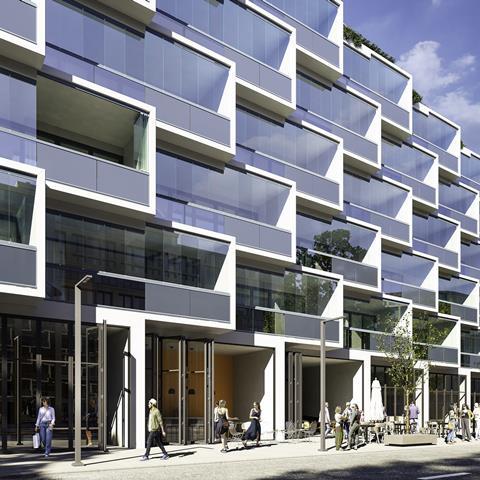
Balcony glazing gives architects of new-build apartments flexibility to design balconies to complement the external building facade. A variety of materials such as aluminium panels and coloured glass can be used to highlight the glazed balcony as a feature. Alternatively, fully glazed balconies can blend in and appear as an integrated aspect of a building that has a fully glazed facade.
Ventilation
Glazed balconies can be designed as either cold spaces or warm spaces that form part of the thermal envelope of the building. Either way, adequate ventilation must be provided.
In a cold glazed balcony, warm moist air from the dwelling may condense on the glazing, but ensuring cross-ventilation across the balcony should remove the moist air and prevent condensation build-up. In a warm glazed balcony, the glazing acts like a conventional window and needs ventilation – via opening vents or glass sashes – to enable air flow and remove moist, stale air.
Specifying to meet regulatory requirements
Glazed balconies must comply with a range of regulations including the Building Regulations, relevant standards and the technical requirements of warranty providers. Below are some of the key performance criteria that they must meet.
Structural loading and fixing requirements
From the deck upwards, a glazed balcony system comprises: a system of glazing acting as a balustrade, a handrail or reinforcing link, and a system of glazing above. As a balcony is considered part of the house, it must meet structural durability requirements: the main structure must last at least 60 years and non-structural parts at least 15 years, unless agreed otherwise with a warranty provider.
The loadings imposed on the building will vary depending on the type of system installed. The type of fixings required will depend on how forces are applied from the glazing, the materials used to construct the building fabric, and live loads including wind. Three common system types illustrate how loads can vary:
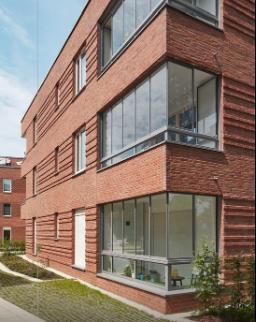
Glazed balustrade and reinforcing link (handrail) – most of the load is transferred down into the slab base, with brackets at either end of the handrail for safe load transfer.
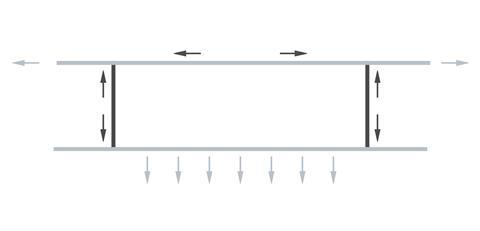
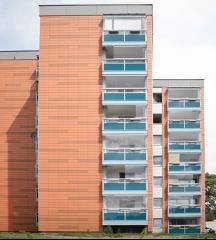
Modular glazed framed system – a full perimeter frame fixed back to the building structure with brackets. The perimeter frame transfers loads to the surrounding building structure at both top and bottom, requiring secure fixings at both levels. Connection details need a structural engineer’s input.
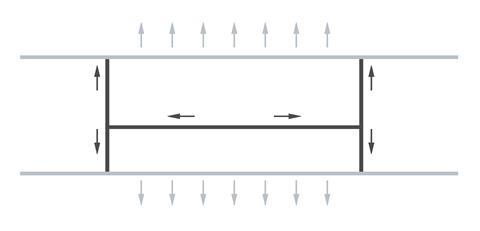
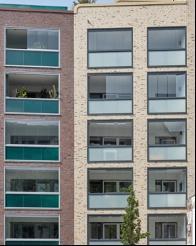
Glass fixed in line in front of structural framing – loads are directed downwards through posts, with base plates fixed to the building structure underneath.
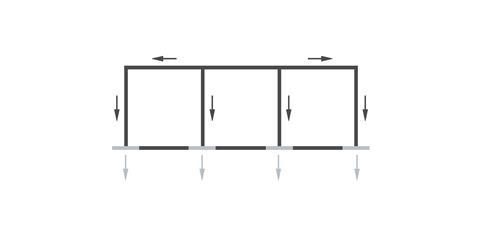
In each case, two sets of structural calculations are required: the project engineer must ensure the building can safely absorb and transfer the glazing loads through load paths down into the foundations; and the glazed balcony system provider must ensure that all associated fixings satisfy the structural stresses placed upon them and have a service life equal to that of the primary structure, which may require corrosion protection such as galvanisation.
Resistance to wind loading
Wind-load calculations will be project-specific and will consider local topography, wind patterns and wind strength. Buildings with unusual shapes, that are close to other buildings, or that are very tall should have their wind loadings assessed through scale-model wind tunnel tests. Expected wind loadings are used by the manufacturers of balcony glazing to ensure glazing and fixings will be able to withstand the forces to which they will be subject. The strength of the glass used can be increased using lamination and/or by increasing its thickness.
Designing balustrades for safety
All balconies must have a balustrade to act as an impact barrier. To meet the requirements of Approved Document K on protection from falling, collision and impact, the top of a balustrade handrail on a balcony must be a minimum of 1,100mm above the final floor level. The strength of glass balustrades can be improved by increasing thickness or through lamination. Alternatively, full-height balcony glazing can be installed behind an existing balustrade.
The balustrade and handrail must meet structural integrity standards covering three types of loading:
- Horizontal line load (kN/m) – a horizontal force uniformly applied to the handrail to simulate a person leaning on it
- Uniformly distributed load (kN/m²) – a horizontal force applied across the midsection of the balustrade to test resistance to a group of people pushing or leaning
- Concentrated point load (kN) – a horizontal point load applied to the balustrade infill to test resistance to sudden localised impact.
For residential balconies, the requirements are: horizontal line load 0.74kN/m; uniformly distributed load 1.0 kN/m²; concentrated point load 0.5kN. For commercial applications and high-density crowd areas, the minimum requirements are higher.
For glass balustrades in residential buildings, gaps between panels must also be small enough to prevent a 100mm sphere from passing through them.
Overheating
Where balconies are exposed to long periods of sunlight, solar gain can make the balcony space itself uncomfortably hot and can also drive up temperatures in adjacent rooms, particularly in south- or west-facing apartments. Approved Document O on prevention of overheating sets out requirements to limit unwanted solar gain and ensure adequate means of purging heat from dwellings. Designers should not assume that a balcony space insulates the dwelling from solar gain – in some configurations it can amplify it. Overheating risk should be assessed early in the design process, as the most effective mitigations are difficult and costly to address after the building’s form has been fixed.
Compliance with Part O is typically demonstrated using either a simplified method or dynamic thermal modelling in accordance with Chartered Institution of Building Services Engineers Technical Memorandum 59 (CIBSE TM59). Where dynamic modelling is used, the thermal properties of the balcony glazing – including its g-value and U-value – will be inputs into the model, so accurate manufacturer data is essential.
There are several ways to reduce overheating risk:
- The g-value glazing selection. The g-value (solar factor) describes how much of the sun’s solar energy passes through the glass. A standard clear glass panel has a g-value of around 0.6; specifying glass with a lower g-value – achieved through solar control coatings – reduces heat transmission while still admitting daylight. For south-facing elevations, a g-value of 0.35 or below may be appropriate.
- Opening panels and ventilation. Glazed balcony systems with openable panels allow hot air to escape and enable cross-ventilation. The ability to open the glazing fully on warm evenings is one of the most practical overheating mitigation strategies and should be considered when choosing between fixed and openable panel configurations.
- External shading. External shading elements – such as projecting soffits, louvres or blinds positioned outside the glazing – are significantly more effective at preventing heat gain than internal blinds, which intercept solar energy after it has already entered the space. The geometry of the balcony above can also act as a shading device for the apartment below.
- Orientation. The overheating risk varies significantly with orientation. South-facing balconies receive the highest solar gain in summer; east- and west-facing balconies are problematic as they are difficult to shade; north-facing balconies present the least risk. Orientation should inform g-value selection and the extent of any additional shading measures.
Accessibility
Balcony glazing systems should be checked against the requirements of Part M of the Building Regulations and the Equality Act 2010 to ensure they do not create barriers for disabled users. Key considerations include handle and operating mechanism heights (ideally between 900mm and 1,200mm from floor level), the force required to operate sliding or folding panels, and the threshold detail at the apartment-to-balcony junction, which should be as level as possible. Manufacturers should be asked to provide operating force data as part of the specification process.
Specific requirements from warranty providers
Glazed barriers require a nominated person to undertake a site-specific design to ensure the guarding for the scheme is suitable and that due diligence has been demonstrated. Always check with the warranty provider – whether Local Authority Building Control (LABC), National House Building Council (NHBC) or another body – to ensure all aspects of the design meet their requirements, as these can vary.
Typical requirements might include:
- Post-failure behaviour of the glass in a barrier should be safe, and failed glass may need to retain sufficient residual strength to preserve life. The designer should clearly demonstrate how containment of the glazing will be achieved.
- For glass infill panels, consideration should be given to not relying solely on low-level mechanical restraint into a base channel – a secondary restraint fixing at high level should also be considered.
- In buildings higher than three storeys, all toughened glazing should be heat-soak tested in accordance with BS EN 14179-1 and permanently marked accordingly.
Drainage
There are several different options for balcony drainage:
- Positively drained – inset or semi-inset balconies are positively drained, meaning water collects on a waterproof surface and is directed to a piped outlet, with an overflow to prevent flooding if blocked. Design must follow BS EN 12056-3 using certified outlet capacity data. Outlets must be positioned to avoid obstructions like decking supports, and subframes or pedestals must be designed to prevent point loads that could damage the waterproofing layer.
- Edge drained – edge drainage allows water to run off the balcony surface and be directed away from the building facade via a continuous gap and soffit collection tray. It can only be used on balconies that project no more than 2.5m from the face of the building. The edge drainage gap should be at least 20mm wide and water should not drain over main entrances, access doorways or private gardens.
- Free drained – free-draining balconies allow water to pass through gaps in the decking surface rather than collecting on a membrane. This is not a method generally favoured by standards, and those warranty bodies that do allow it impose caveats around support arms, structural upstands, gap sizes and drainage positioning.
Positively drained and edge-drained balconies give more control over surface water management and therefore tend to be favoured.
Fire safety
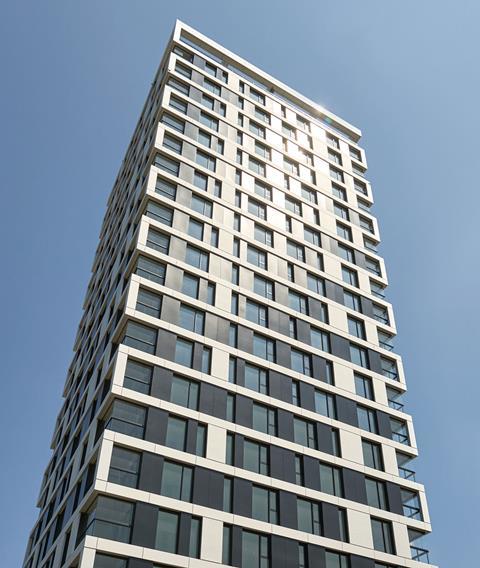
Materials permitted for use on balconies are governed by Approved Document B on fire safety (ADB). For residential buildings above 18m, regulation 7(2) of the Building Regulations imposes a statutory ban on combustible materials in external walls, including balconies. For buildings between 11m and 18m tall, the ADB sets out guidance requiring balcony materials to achieve Euroclass A2-s1, d0 or A1 ie to be non-combustible. While this is guidance rather than a direct regulatory prohibition, departing from it requires demonstrating an equivalent level of fire safety – which in practice means the A2-s1, d0 requirement should be treated as the effective standard for all residential buildings above 11m.
Glass laminated using a standard PVB interlayer does not meet this criterion, as PVB is a combustible thermoplastic and typically achieves no better than Euroclass E. However, not all interlayer materials behave the same way. Ionoplast interlayers – such as those used in structural and fire-rated laminated glass – can achieve significantly better fire classifications, and some specialist fire-rated laminated glass products are available that do comply with the A1 or A2-s1, d0 requirement. The interlayer type and the specific product’s tested Euroclass classification must be confirmed with the manufacturer. Where acoustic performance is also a requirement, specifiers should check whether a fire-rated interlayer can still deliver the required Rw values, as the acoustic and fire properties of interlayer materials differ.
There are defined exceptions to the non-combustible requirement covering items such as seals, gaskets, membranes, thermal break materials and electrical installations – always check the current version of ADB for the full list.
Balconies often involve complex detailing at the junction with the wall, but it is vital that this does not compromise the continuity of cavity barriers or fire stopping. Ideally, brackets fixed to the inner leaf of a cavity wall should be placed above or below horizontal cavity barriers. If that is not possible, brackets must include features such as thermal wrapping to maintain fire separation and must be supported by relevant fire-test evidence from the manufacturer.
Thermal performance
The requirements of Approved Document L on conservation of fuel and power do not usually apply to balconies, as they are not heated spaces. However, if balcony glazing is used to transform a cold balcony into a warm habitable space, it is likely to be treated as a new fabric element in an existing dwelling, requiring a minimum U-value of 1.4W/m²K or window energy rating band B minimum. Always confirm exact thermal requirements with building control.
Key standards
The following standards are relevant to the specification of glazed balconies:
- BS 8579 Guide to the design of balconies and terraces – provides a unified framework for the safe design of balconies and terraces, covering drainage, structural requirements and other design components.
- BS 6180 Barriers in and about buildings. Code of practice – covers the design, height, strength, materials, fixing methods and structural requirements of barriers including balustrades, including a 25mm maximum displacement limit for glass balustrades.
- BS EN 1991-1-1 Eurocode 1 – balcony balustrades used as guarding should be designed in accordance with this standard to ensure they resist horizontal loading.
- BS EN 1991-1-4 Eurocode 1: Wind actions – sets out how to calculate wind pressures and forces on structures, considering building geometry, terrain and turbulence. Applies to individual components such as balconies.
- BS EN 1991-1-3 Eurocode 1: Snow loads – gives guidance on snow load values for structural design. Balconies should be designed to account for this load.
- BS EN 12056-3 Gravity drainage systems – applies to wastewater drainage systems operating under gravity, including drainage systems for balconies.
Planning permission
Another thing to consider is that adding glazing to an existing balcony can require planning permission, as it changes the external appearance of the building. This is particularly likely to be the case for properties in conservation areas, listed buildings, or where the local authority has removed permitted development rights through an article 4 direction. For new-build developments, balcony glazing will form part of the planning application for the building as a whole. For retrofit projects, early engagement with the local planning authority is advisable before a system is specified, as requirements vary.
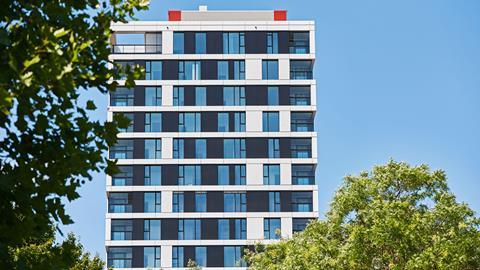
The lifecycle of balcony glazing
The following are issues to consider across the lifecycle of a glazed balcony.
1. Design
As we have seen, the design of a glazed balcony must consider the benefits and features that appeal to users as well as relevant regulations and standards. This applies to both new-build and retrofit, though the latter may represent more of a challenge as the design may have to accommodate existing features such as a balustrade and drainage system. From a project management perspective, the simplest approach may be to provide all relevant information about dimensions, loading, wind uplift and drainage to an experienced balcony-glazing manufacturer who can develop a compliant solution.
2. Installation
Installation of balcony glazing is a specialist task, and the skill of the installers can have a large impact on the quality of the finished balcony. Installation is made easier where all parts of the glazing are supplied and installed by the same manufacturer, as the components are designed to fit together and installers will be familiar with the system. Where a glazed balcony is comprised of products from different manufacturers, this can complicate matters and requires good communication and clear understanding between designers and installers.
3. Maintenance
The exact maintenance regime required will vary by manufacturer, and users should always follow the instructions for their own system. In general, maintenance involves regular cleaning of glass surfaces and frames using mild detergent and appropriate non-abrasive materials, together with annual checking and lubrication of seals and hardware. Power washers and harsh chemicals should be avoided as they can damage the glass and frames. Specifiers should ensure that residents are provided with the manufacturer’s specific maintenance instructions at handover.
4. End of life
Glazed balcony systems have a long service life, but what will happen when a system reaches the end of its useful life should be considered at specification stage:
- Glass – the glass panels used in balcony glazing are made from glass, which is technically very recyclable. However, laminated glass – used extensively in balcony applications for both acoustic and safety reasons – presents a recycling challenge because the interlayer bonding the panes together makes conventional cullet recycling impractical. Specialist recycling processes exist that can separate the glass from the interlayer, but these are not universally available. Toughened monolithic glass can be recycled more straightforwardly. Specifiers and clients with sustainability commitments should discuss end-of-life glass handling with the system manufacturer at the outset.
- Aluminium framing – aluminium is one of the most recyclable materials in construction, and can be recycled repeatedly without loss of quality, requiring only around 5% of the energy needed to produce primary aluminium. At end of life, framing, tracks and hardware should be segregated and directed to metal recycling. Some manufacturers operate take-back or component recovery schemes.
- Responsible disposal – removal and disposal of a glazed balcony system should be carried out by a competent contractor familiar with the system. Large glass panels present obvious safety risks during removal, and any intumescent or fire-stopping materials must be handled and disposed of in accordance with relevant waste regulations. Where a system is being replaced, the condition of existing fixings, brackets and structural connections should be assessed by a structural engineer before a new system is specified.
- Circular economy – when specifying balcony glazing, it is worth asking manufacturers about the recyclable content of their systems, whether components can be disassembled and reused rather than demolished, and whether the system design supports replacement of individual panels rather than wholesale replacement of the entire assembly.
Case study: Silverton apartments
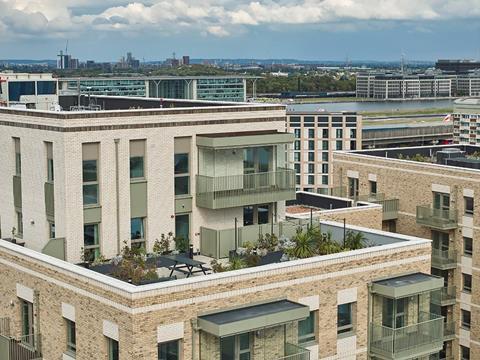
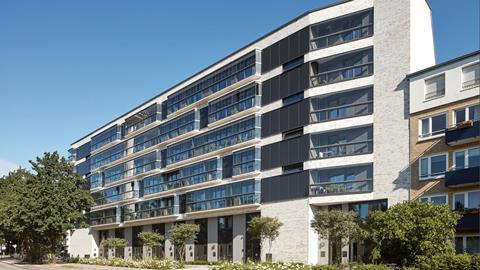
The Silverton, in east London’s Royal Docks, is a development of luxury apartments by Fairview New Homes. Located near the Tate & Lyle sugar refinery and London City Airport, the 11-storey development required balcony glazing to create sheltered outdoor living spaces that reduced noise pollution and met wind-loading requirements. Aircraft noise from the airport, combined with background noise from local industry, meant acoustic performance was particularly critical.
A slide-and-turn glazing system was chosen for its aesthetic qualities and ease of use. The non-thermally broken balcony enclosures featured 12mm glazing and careful detailing to ensure acoustic performance, and the result was a 25dB reduction in sound.
The development’s height and exposed location meant the glazing had to withstand significantly higher wind loads than a typical low-rise project. Wind at height is stronger, and tall buildings also experience funnelling effects – where wind accelerates as it is squeezed around corners or between structures – creating localised gusts that can exert considerable force on glazed surfaces. The glazing system also needed to accommodate a degree of building movement, as tall buildings flex slightly in high winds and shift over time as they settle.
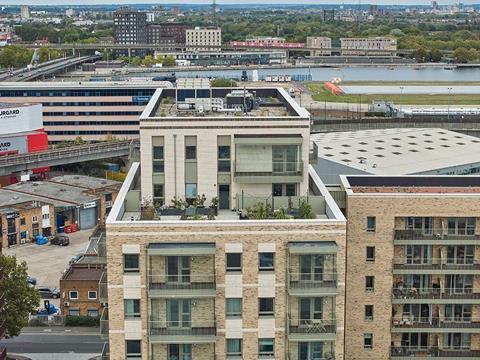
To meet these demands, the system used reinforced aluminium frames and a top-running track, where panels hang from a track above rather than sitting in a bottom channel – an arrangement better suited to resisting the sideways forces that wind imposes on the panels. A height-adjustment profile was incorporated into the system, allowing individual panels to be precisely aligned and re-aligned as the building moves, preventing panels from binding or falling out of true. The system was engineered to meet the specific wind-loading requirements on each face of the building, which varied depending on orientation and the surrounding built environment.
The appearance of the system was also important. Solarlux Proline T and Proline T Mega systems were used because they offer slim profiles and uninterrupted glass spans, ensuring the balconies integrated seamlessly into the building’s contemporary design. A mix of balcony treatments was required: full-height glass enclosures on upper levels to maximise protection from wind and weather, and half-height enclosures at lower levels. Because both were designed and manufactured by the same firm, a consistent look was achieved across both.
Please fill out the form below to complete the module and receive your certificate.